
"Being smart can hurt your career in some companies. How do you explain that?"
2 min read
"Being smart can hurt your career in some companies. How do you explain that?"
I got this comment (which I rephrased for clarity) in a previous post and it got me thinking...
"Surely it can't be true!" -- I thought. "Why does he think it's so?"
Here's one theory:
👉 Being smart is never a handicap.
It's always good, it's always valued and it always increases your chances of promotion.
👉But it's not the only thing that matters.
🎯 And because some of the other things that do matter are not observable to most people, we might be led astray into thinking that intelligence is a handicap when it actually isn't.
Let me explain:
There are two kinds of factors that determine how much someone is valued in a company:
1️⃣ Ostensive factors are caracteristics of an employee that anyone can assess and judge for themselves. They incude whether the individual is smart, articulate, a team-player etc.
2️⃣ Secretive factors, however, are caracteristics of an employee which are unkown to most of their peers. In fact, secretive factors are often considered taboo: family ties, friendships dating back to high school, extra-marital affairs and, perhaps most importantly, what I'll call Usefulness.
Usefulness is the extent to which one's superiors perceive this person as being useful to achieve certain goals.
A useful person might be someone who...
... follows orders without questioning, 🫢
... is willing to do the dirty work so someone else can keep their hands clean,😈
... or even someone who'se willing to work on their boss's personal projects. 🧑💻
Usefulness is a particularly relevant variable, because it is observable mostly by people who wield power and may thus make people rise through the corporate ladder. 🪜
There are many examples of both ostensive and secretive caracteristics, but I'll use Intelligence and Usefulness to keep things simple.
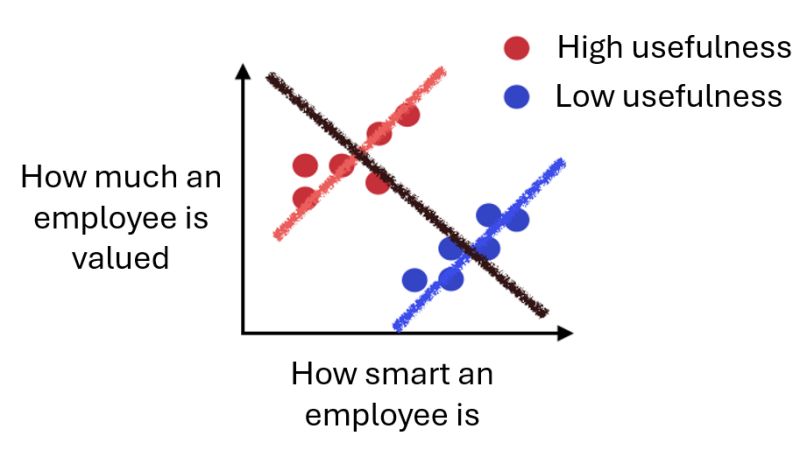
🔺 Supose, for simplicity, there are two groups of people in the company: people who have high usefulness and people who have low usefulness.
👉 In both groups, being intelligent is important for being valued. In other words, being intelligent is a good thing, whether an employee is Useful or not.
👉 However, because usefulness is not observed by most people, most people do not see these groups are separate. All they see is one, big, group.
👉 As a result, most people end up with a biased estimate of the effect that intelligence has on being valued.
🎯If the effect of Usefulness is strong enough, you might end up with a negative relationship between being intelligent and being valued: it may seem the more intelligent an employee is, the less valued s/he'll be.
🎯 But this is a mere illusion, a consequence of the erroneous belief that we're seeing all relevant variables.
As Hamlet would say:
"There are more things between Heaven and Earth, Horatio, than can be dreamt of in your philosophy" 💀